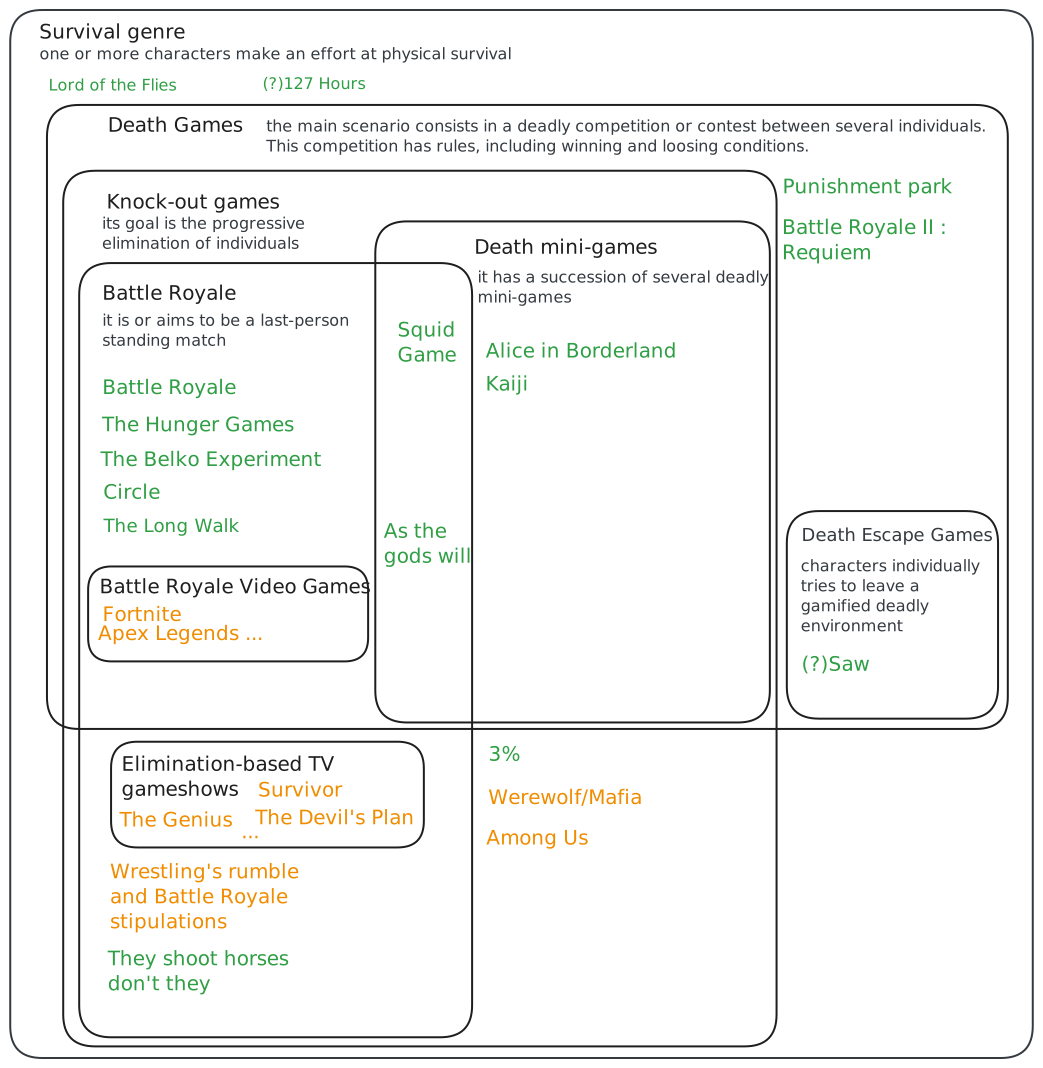
I have always felt frustrated when looking at the classification of books and movies related to Battle Royale and death games genres. Indeed, I believe, they are not mere tropes, but rather genres in their own right, and a proper classification is needed. Here is an attempt to such classification, that focuses on the content and rules of the games involved in these medias, rather than other elements that one may find in broader genres such as thriller or horror.
Indeed, this attempt was first an answer to the classification of Battle Royale (BR) and Alice in Borderland (AiB), often being classified as part of the horror and survival genres. However, I believe that: 1. Although both of them should be part of the survival genre, they can't be thought as similar 2. I believe there should be a clearer distinction between genre as the main focus of the piece of art, and the tropes used inside. In that sense, I believe that 'horror' (here, mostly understood as gore content) in both BR and AiB are a trope rather than a genre, it's not the focus, but rather mere consequences of the storylines. Such elements are used to add emphasis on some key moments or to raise the stakes of character's actions' consequences, but they are never the main elements of the story. 3. Squid Game is often compared to BR, although I believe it is much much closer in genre to AiB
Especially, I'm interested in the distinction between content that focuses on a single event in which only one survivor should remain, compared to a succession deadly mini-games that may result in several individuals remaining alive. For example The Hunger Games (book 1 of the trilogy) has a clear focus on the game in which Katniss is participating. Rather than a dystopian novel about class struggle between the districts and the wealthy Capitol (which is the main focus of book 3, and to some extent of book 2), the book follows how Katniss survives the 74th Hunger Games, a deadly battle royale where only one participant can survive. In that sense, it is very similar in genre to Battle Royale or The Long Walk. To me, The Hungers Games (book 1), is before all a book about a battle royale. On the other hand, the premise of Squid Game is to play a series of children's games. It focuses on how 기훈 manage to survive each game one by one. The elimination of other participants is used as a mechanism to increase the stakes of the games. Indeed, Squid Game isn't a Battle Royale per se, because it is not defined (see below for my list of rules of the Battle Royale genre) strictly as having a single winner. Indeed, it is advertised to 기훈 as giving a chance to win up to 45.6 milliards de Won (if he is the last player standing). Therefore, the game acknowledge that several participants may win Squid Game. However, based on how the games unfold in all three seasons, it seems reasonable to expect that in the minds of Squid Game's organizers, they want a sole winner, making it a Battle Royale de facto.
Therefore the rules of the Battle Royale genre are as follows: 1) Several participants play a game ; 2) This game is defined by a set of rules (and therefore, is somewhat supervised by something or someone), including a rule for elimination and a rule to determine a winner ; 3) This game must be designed to let only a single participant (or group of participants) win ; 4) (Necessary only to Battle Royale as part of the Death Games genre) Death results in elimination, and elimination results in death.
Participants may or may not have given their consent to participate in the competition. Rules may be more or less explicit (e.g. Battle Royale and The Hungers Games both have a clear ruleset, while in Circle, participants learn the rules by playing). Here, a game is defined by its ruleset, therefore it may not be fun, and participants may have very limited agency. It should be reminded to the reader that the Battle Royale genre may be non-violent, and keep elimination as a standard removal from the game.
This classification includes many different types of medias (in green): books, movies, TV shows, animes, mangas, comics, webnovels and manhwa. I added other type of medias that may not be considered as art (depending on how one defines art) for comparison (in yellow), including: video games, board games and TV reality shows. Elements marked with a '(?)' are content that I did not read/watched, so my interpretation of them may be wrong. I also purposively did not add examples of the broad survival genre, such as most of the RPG-fantasy genre, as well as many action/thriller pieces of art such as Jurassic Park or most of the apocalypse-movies, in which I believe survival is more a consequence of the plot rather than survival being the main element of the story.
It has to be noted that being in this classification doesn't mean I liked it, but I can strongly recommend Battle Royale (both the book and the movie), Alice in Borderland (the manga, but also the Netflix adaptation up to season 2), Punishment Park and The Genius (south korean TV show). Finally, no classification is perfect. In the end, it is just another way of putting things in boxes in order to better understand the world, so do not expect 100% accuracy with this classification.